The Brief
What the project needed to accomplish
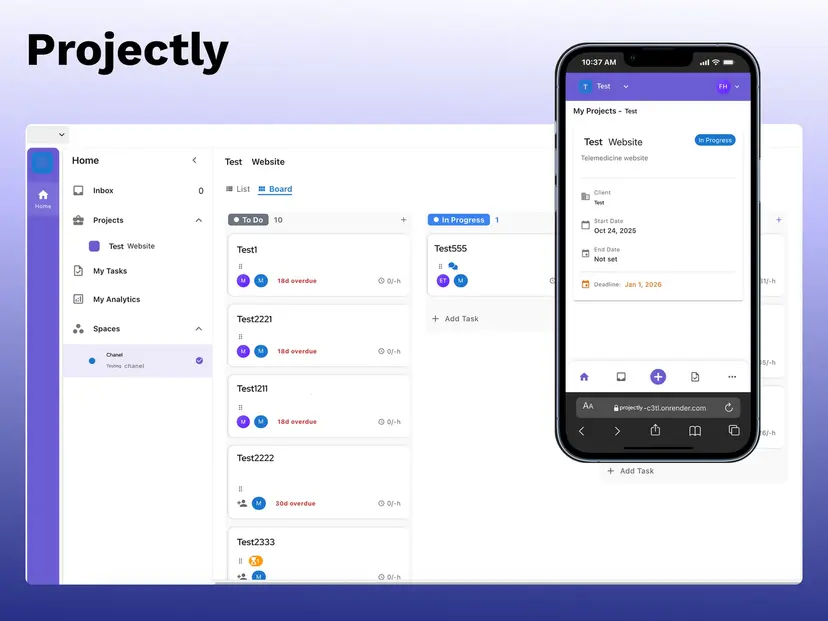
Projectly is a custom-built CRM developed to replace costly third-party tools and give the client full control over their internal operations.
Case Study 2026
Projectly is a custom native CRM built to replace generic tools, streamline workflows, and give teams full control over how they work.
Performance Snapshot
7%
From 4%
Sales Growth
25%
From 15%
Customer Retention Rate
18%
From 10%
Cart Abandonment Reduction
The Brief
Projectly is a custom-built CRM developed to replace costly third-party tools and give the client full control over their internal operations.
The Challenge
The company was previously relying on platforms such as Monday, paying over €500 per month while still adapting their workflows to fit the tool’s limitations. Processes were fragmented, features were underused, and recurring subscription costs were steadily increasing without proportional value.
The Solution
The goal of this project was to design and build a native, fully customized CRM tailored specifically to the company’s workflows. By recreating and improving the functionality they relied on most, the system would reduce operational costs, save time, and free up budget to be reinvested into growth, team expansion, or product development.
The Outcome
The existing CRM setup was expensive, generic, and inefficient. Although tools like Monday offered flexibility, they were not designed around the company’s exact needs. Teams were forced to work around predefined structures, leading to unnecessary manual steps, duplicated data, and inconsistent processes across departments. The subscription-based model created a growing financial burden as the team scaled, while advanced features remained unused or locked behind higher pricing tiers. Reporting lacked relevance, automation was limited, and customization options were constrained. The company needed a solution that felt native, scalable, and purpose-built — without recurring per-user costs. We designed and developed Projectly, a fully custom CRM built from the ground up based on the client’s real workflows and priorities. Instead of adapting the team to the software, the software was designed to adapt to the team. Core CRM functionality was replicated and optimized, including contact management, pipeline tracking, task automation, internal notes, and reporting. In addition, custom-built features were introduced to match the company’s specific operations, eliminating unnecessary tools and reducing context switching. The system was developed as a native internal platform, giving the company full ownership of the product. This removed monthly subscription costs entirely and allowed unlimited scalability without increased fees. Automation flows were customized to reduce repetitive tasks, saving time across sales, operations, and management. The interface was kept clean and functional, prioritizing speed, clarity, and ease of use. Every module was built to be extendable, allowing future features to be added without restructuring the system. The CRM was also optimized for performance and long-term maintainability, ensuring it could grow alongside the business. After launching Projectly, the company successfully eliminated recurring CRM subscription costs, saving thousands of euros annually. Internal workflows became faster and more consistent, with significant reductions in manual work and duplicated processes. Teams reported improved visibility across pipelines and operations, better data accuracy, and smoother collaboration. Most importantly, the freed-up budget could be reallocated toward higher-impact areas such as hiring, marketing, and product development. By moving away from a generic third-party platform and investing in a custom-built solution, Projectly became a strategic internal tool rather than just another software expense — supporting efficiency, scalability, and long-term operational control.